Decoding Your Tire Placard: A Guide to Understanding the Information on Your Tires
Learn what every field on your tire and loading information placard means - OE tire size, cold inflation pressure, GVWR, and how to read P225/65R17 102H.
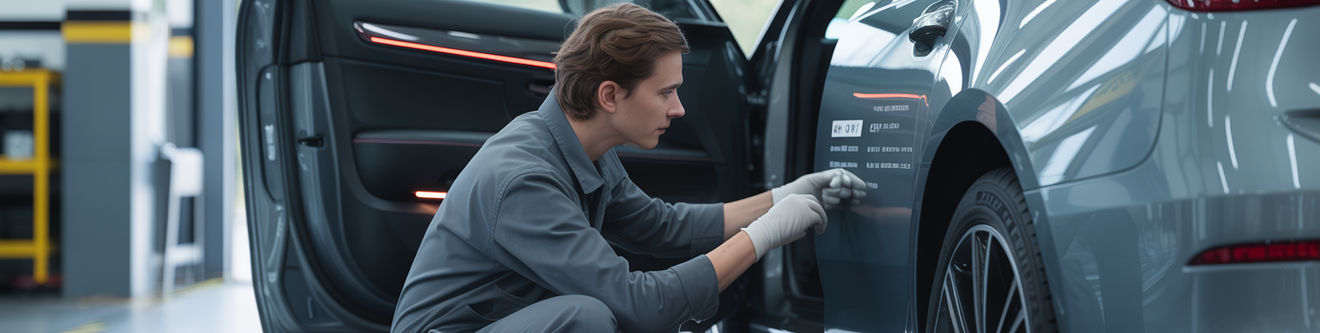
Pop open the driver's door of any modern passenger vehicle and you'll find a small white sticker tucked into the door jamb. That's the tire and loading information placard — a label the federal government requires every automaker to attach, in a specific format and location, on every vehicle under 10,000 pounds. The placard is the manufacturer's official spec sheet for what your chassis, suspension, brakes, and steering were engineered to handle. It tells you the original equipment tire size, the cold inflation pressure for each axle, the maximum combined weight of occupants and cargo, and the seating capacity the vehicle was certified for.
If you've ever bought new tires, towed a trailer, loaded up for a road trip, or chased down a slow leak, every answer you needed was probably on that little sticker. This guide walks through every field on the placard, what each one means, why it matters, and what to do when the information is missing, faded, or no longer matches your vehicle.
Where to Find the Tire Placard
Federal Motor Vehicle Safety Standard 110 (FMVSS 110) — the regulation that governs tire selection and placards — requires the placard to be "permanently affixed to the driver's side B-pillar" on vehicles under 10,000 pounds GVWR. The B-pillar is the vertical post between the front and rear doors; the placard sits on the body side of that post and faces you when the driver's door is open.
Not every vehicle has a B-pillar (think two-door coupes, some trucks, and minivans with sliding doors), so the regulation allows a few alternates. According to FMVSS 110, the placard can appear on the rear edge of the driver's door, the forward edge of the rear side door, or another visible location near the driver's seat — as long as it stays "legible, visible and prominent."
In the real world, that means if you can't find your placard on the door jamb, check these other locations:
- The rear edge of the driver's door itself (the side that faces the body when closed)
- Inside the fuel-filler door
- Inside the glove box, often on the inner lid
- Inside the center console lid
- On the trunk lid or rear hatch (older vehicles)
- Inside the engine compartment, near the firewall (rare, mostly classic vehicles)
What's on the Placard, Field by Field
Under FMVSS 110, the placard must display nine specific pieces of information. Some are mandatory; two are optional. Here's what every field means and why it matters.
1. "Tire and Loading Information" header
Every compliant placard is titled "Tire and Loading Information" so it can't be confused with the certification label, the VIN sticker, or any aftermarket sticker stuck to the door jamb. If the label in front of you doesn't say that, you're probably looking at a dealer-added sticker or a tire-shop reminder — not the OEM placard.
2. Seating capacity
The total number of seating positions the vehicle was designed for, broken down by row. A typical mid-size SUV reads something like "Seating Capacity: Total 7, Front 2, Center 3, Rear 2." The number isn't a suggestion — it's the maximum the vehicle's seat belts, airbags, and structural design were certified for. Carrying additional passengers means at least one rider is unbelted in a crash.
3. Combined weight of occupants and cargo
Often phrased as: "The combined weight of occupants and cargo should never exceed XXX kg or XXX lbs." This is the single most important number on the placard for anyone who tows, hauls, or road-trips with a full vehicle.
This figure is calculated from the Gross Vehicle Weight Rating (GVWR — what the fully loaded vehicle is allowed to weigh) minus the vehicle's curb weight (what it weighs empty with a full tank). What's left is everything you can put inside: people, luggage, dogs, tools, roof racks, hitch loads. Exceed this number and you're overloading the tires, brakes, and suspension that everything else on the vehicle depends on.
4. Original Equipment (OE) tire sizes
The placard lists the tire sizes the vehicle was originally engineered around, typically split into three rows:
- Front: the OE tire size for the front axle (e.g., P225/65R17)
- Rear: the OE rear size — usually identical to the front on passenger vehicles, sometimes different on performance and rear-wheel-drive cars ("staggered" fitment)
- Spare: the spare tire size — often a smaller "temporary" or "compact" spare (T-rated, narrower, with a max speed of 50 mph)
These are the sizes the chassis, fender clearances, speedometer calibration, and traction-control software were tuned for. Replacing them with a different size changes how the vehicle handles, how accurately the speedometer reads, and whether the load index still supports the GVWR.
5. Cold inflation pressure (front, rear, spare)
Per USTMA (U.S. Tire Manufacturers Association), the placard PSI is the recommended pressure when tires are cold — meaning the vehicle has been parked for at least three hours or driven less than a mile. Pressure rises as tires heat up from driving, so checking warm tires gives an inflated (no pun intended) reading.
A common configuration on a mid-size SUV: 35 PSI front, 32 PSI rear, 60 PSI spare. The front and rear can differ because the front axle of most vehicles carries more weight (engine and transmission live up there). The spare is often much higher because compact spares are smaller and run at high pressure to support full vehicle weight.
6. "See Owner's Manual for Additional Information"
This line is required by FMVSS 110. It points you to the owner's manual for the long-form explanation of load limits, tow ratings, hitch capacities, and what to do if you've added equipment that changes the vehicle's weight.
7. Non-pneumatic spare identification (when applicable)
If your vehicle was delivered with a run-flat or non-pneumatic spare, the placard lists the tire identification code for that spare. This is rare on consumer passenger vehicles and more common on some BMW, MINI, and certain trucks.
8. Load range, load index, and speed rating (optional)
Automakers may — but aren't required to — print the load index and speed rating on the placard. When they do, you'll see something like P225/65R17 102H: the "102" is the load index (the maximum weight one tire can carry at its rated pressure) and "H" is the speed rating (the maximum sustained speed the tire is certified for). We'll walk through how to decode that string in the next section.
9. Manufacturer barcode (optional)
Some placards include an alphanumeric code or barcode that ties the placard to the vehicle's build records. You can ignore this as a driver — it's used by the assembly plant and by recall investigators.
How to Read a Real Placard
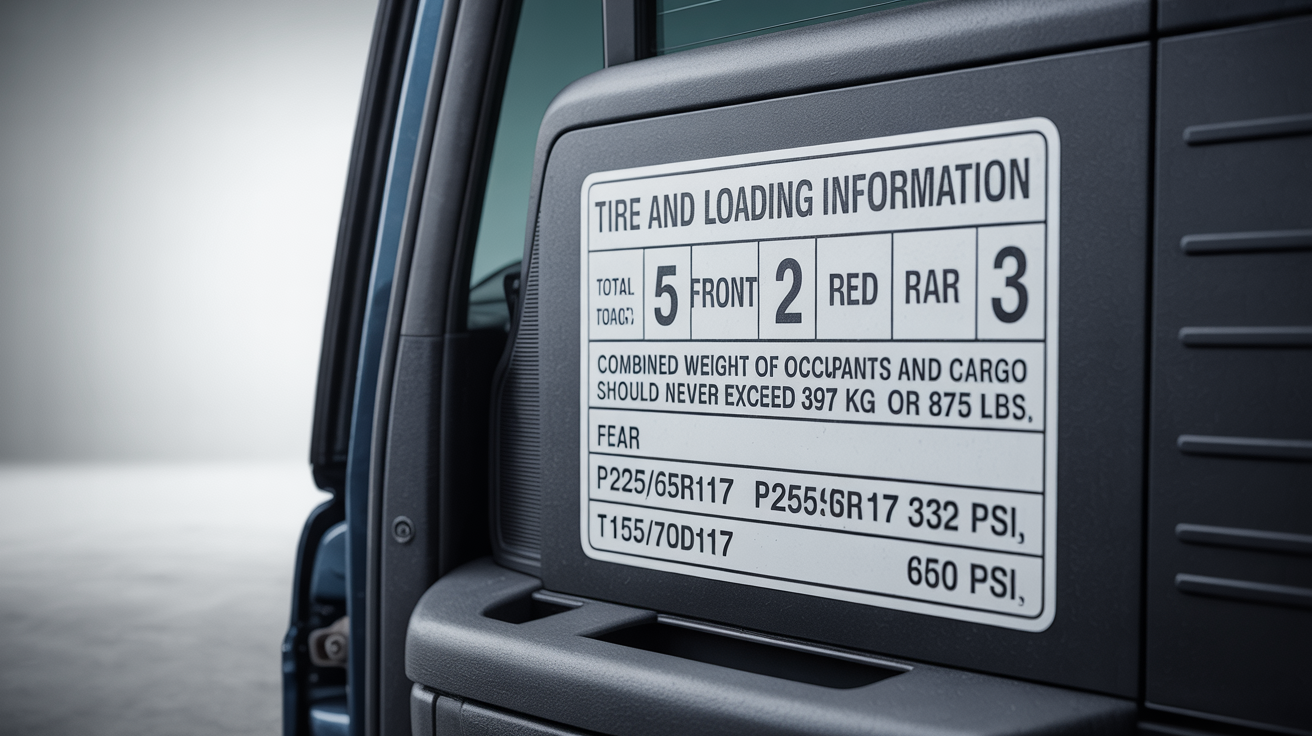
Let's walk through a representative example. Pretend you've opened your driver's door and you see this on the B-pillar:
Seating Capacity: Total 5 — Front 2, Rear 3
The combined weight of occupants and cargo should never exceed 397 kg or 875 lbs
Original Tire Size:
Front: P225/65R17 102H @ 35 PSI
Rear: P225/65R17 102H @ 32 PSI
Spare: T155/70D17 @ 60 PSI
Here's what each piece tells you, left to right:
The tire size string: P225/65R17 102H
- P — Passenger-vehicle (P-metric) tire. An "LT" prefix would indicate a Light Truck tire built for heavier loads; no prefix indicates a Euro-metric size.
- 225 — Section width in millimeters. The tire measures 225 mm across at its widest point when mounted and inflated.
- 65 — Aspect ratio. The sidewall is 65% as tall as the tire is wide — so 225 × 0.65 ≈ 146 mm of sidewall height.
- R — Radial construction (the universal standard for modern passenger tires).
- 17 — Wheel diameter in inches. This tire fits a 17-inch rim — period. Not 16, not 18.
- 102 — Load index. A load index of 102 corresponds to about 1,874 pounds per tire at the tire's rated pressure. Four tires × 1,874 lbs ≈ 7,496 lbs of total load capacity (well above what any P-metric passenger application needs).
- H — Speed rating. "H" is certified to a sustained 130 mph. Common alternatives: T (118 mph), V (149 mph), W (168 mph), Y (186 mph). The rating reflects how the tire was tested, not a speed you should drive.
The pressures: 35 / 32 / 60 PSI
35 PSI front and 32 PSI rear means the engineer expects more weight up front (engine + transmission) and tuned the front tires to a higher pressure to compensate. The 60 PSI spare is a compact T-rated spare — narrower than the OE tire, designed to be driven gently to a tire shop, not used as a long-term replacement.
The weight limit: 875 pounds
Five seating positions × an average occupant weight of about 150 lbs = 750 lbs of just passengers. That leaves 125 lbs for cargo before you exceed the placard limit. This is why you can't pile a fully loaded SUV with five adults, three suitcases, and a 200-lb roof box without consequences — you're already over the rated combined weight.
What the Placard Doesn't Tell You
The placard is dense, but it's not exhaustive. A few things you won't find there:
- UTQG ratings. Treadwear, traction, and temperature grades are molded into the tire sidewall — not on the placard.
- M+S, 3PMSF, or all-weather designations. Whether a tire is mud-and-snow rated or earns the Three-Peak Mountain Snowflake symbol is sidewall information, not placard information.
- DOT date code. The week-and-year a tire was manufactured is in the DOT serial on the sidewall.
- Maximum sidewall pressure. The placard gives the recommended cold pressure for your vehicle. The maximum the tire is rated to hold is stamped on the sidewall in much smaller print — and it's almost always higher than what the placard recommends.
- Tow ratings and hitch weights. These are in the owner's manual and on a separate towing label on most trucks and SUVs.
If you want to dig into what the sidewall is telling you, our companion piece Cracking the Code: Understanding the M+S Tire Brand walks through every marking on the rubber itself.
Common Scenarios
My placard is faded, missing, or rubbed off
First, check the alternate locations listed above. If you genuinely cannot find a legible placard, you have three reliable fallbacks:
- Look up your VIN in NHTSA's vPIC database. The free NHTSA VIN Decoder returns OE specifications (where available) for any U.S.-market vehicle from 1981 onward.
- Check your owner's manual. The placard data is also printed in the "Specifications" or "Tires and Wheels" section.
- Call the manufacturer's customer service line. Toyota, Ford, GM, Honda, and every other major OEM will look up the original spec by VIN over the phone. Most can mail you a replacement placard.
I've changed to a different tire size
If you (or a previous owner) installed a non-OE size — common when going from steel wheels to aftermarket wheels, or when plus-sizing — the placard PSI is no longer exactly right. The placard pressure was tuned for the OE tire's volume and load index. A different-sized tire with a different volume will need a different pressure to deliver the same load capacity and ride.
The honest answer: use the OE pressure as a starting point, then have a tire professional cross-reference the new tire's load index against the OE load index and adjust. Going up a load index typically means you can stay at the placard PSI; going down means you may need more PSI to compensate. Never exceed the tire's maximum sidewall pressure.
I've added equipment (lift kit, bed cap, heavy roof rack, accessibility modifications)
FMVSS 110 includes a separate provision (S10) for dealer-added or vehicle-modifier–added equipment that reduces the load-carrying capacity. If the equipment weighs more than 1.5% of the GVWR — or if the modifier reduces the load capacity by 100 kg (220 lbs) or more — they're required to affix a Load Carrying Capacity Modification Label alongside the original placard. This second sticker tells you the new, lower combined occupant-and-cargo weight you should respect.
If you bought a vehicle with aftermarket equipment installed and there's no modification label, get the equipment weighed at a CAT scale or commercial truck stop and subtract that weight from the original placard limit yourself. It's not as precise as the engineering, but it's better than guessing.
I'm shopping for replacement tires and want to be sure I get the right size
The OE tire size on the placard is the manufacturer's recommendation — it's what your suspension, brakes, transmission, and TPMS were calibrated for. Buying the same size guarantees fitment, speedometer accuracy, and warranty compliance.
Once you know the size, the next question is what to pay. Most tire shops advertise the tire price, but the drive-out price — what you actually pay after mounting, balancing, valve stems, road-hazard fees, tire disposal, and tax — can be 20-40% higher. SearchTires compares drive-out prices at local installers so you know what you'll actually pay before you book the appointment.
Related Topics
Keep going with these companion guides:
- How to Check & Set Tire Pressure — once you know the placard PSI, here's how to verify and maintain it with a quality gauge.
- Cracking the Code: Understanding the M+S Tire Brand — what the sidewall markings mean and why M+S, 3PMSF, and all-weather designations matter.
- How Long Do Tires Last? — when to replace your tires regardless of tread depth, plus how to read the DOT date code.
- Beyond All-Season: Exploring All-Weather and Premium Traction Tires — when the OE all-season tire isn't the best replacement choice for your climate.
- Tire Safety & Blowout Statistics 2026 — NHTSA data on underinflation, blowouts, and the safety stakes of staying within placard limits.
- What Is Drive-Out Tire Pricing? — once you've decoded the placard size, this is how to actually shop the price.
Frequently Asked Questions
Where is the tire placard on my car?
Should I use the PSI on the placard or the PSI on the sidewall?
Why are the front and rear pressures different?
What does GVWR mean and is it on the placard?
Can I install a different size tire than what's on the placard?
What if my placard is missing or unreadable?
Why does the spare tire have such a high PSI?
Does the placard apply to my truck if I've added a topper or bed cap?
Sources
Sources used in this article, grouped by section:
Federal regulation
- 49 CFR § 571.110 — FMVSS 110 Tire Selection and Rims — the federal regulation governing tire selection, placard placement, and required content for vehicles under 10,000 lbs GVWR (Cornell Legal Information Institute, accessed 2026).
- eCFR — 49 CFR Part 571.110 — official electronic Code of Federal Regulations text.
- Federal Register — 2010 Cargo Carrying Capacity rule — clarifies the Load Carrying Capacity Modification Label requirement (S10) for dealer-added equipment.
Placard location and reading
- Tire Rack — How Do I Read My Tire Placard? — Tire Rack's consumer guide to reading placard fields and locating the sticker on the vehicle.
- Autel — Tire Pressure Placard Overview — additional consumer reference on placard location and contents.
Inflation and pressure guidance
- USTMA — Tire Care Essentials — U.S. Tire Manufacturers Association guidance: check pressure cold, monthly, before long trips; pressure changes 1-2 PSI per 10°F.
- USTMA — Tire Care & Safety hub — broader tire-maintenance reference.
VIN lookup and recovery
- NHTSA vPIC VIN Decoder — official NHTSA tool to look up vehicle specifications by VIN when the placard is missing or illegible.
- NHTSA vPIC API documentation — programmatic access to the same data.
Tire size and rating decoding
- Bridgestone — Tire Speed Rating — speed-rating chart (H = 130 mph, V = 149 mph, W = 168 mph, Y = 186 mph).
- Michelin — Tire Load and Speed Ratings Explained — manufacturer reference on load index conversion to pounds and speed-rating meanings.
- Pirelli — Tire Speed Rating — additional manufacturer reference on speed-rating chart and load index.
Once you've decoded the placard and you know the OE tire size your vehicle was engineered for, the next question is where to actually buy. Before you book an installation appointment, search your tire size or vehicle on SearchTires to compare drive-out prices at local tire shops — what you'll actually pay after mounting, balancing, and fees, not just the advertised tire price.
© 2026 SearchTires.com